Showing posts with label culture vulture. Show all posts

Tuesday, March 31, 2015

La Vie La Cage


Managed to catch La Cage Aux Folles by 9 Works Theatricals last Friday, and enjoyed it so much I simply had to do an encore for their final performance Sunday afternoon.

What to say, what to say, really?

First off, I thought the production was appropriately splendiferous. The glitter, the glam, the shimmer and sparkle of the titular, legendary St. Tropez cabaret was captured in the fabulous costumes, dazzling confections created by members of the Fashion Designers Association of the Philippines. The stage sets by Mio Infante also evoked the ambience of the French Riviera, both in the interiors of Chez Georges et Albin, and the exteriors representing the resort town of St. Tropez.


The choreography and music were energetic, impressive, and riveting. The Cagelles - singly and as a group - fulfilled their promise in the opening song "We Are What We Are" that "you'll love us once you get to know us." Indeed, how could you not love the breathless tap dancing, the raunchy can-can, and the various individual vaudeville acts ( Hannah from Hamburg, j'adore!) ?

Indeed, La Cage gets off to a grand, fabulous start, and sets off from there like a psychotic horse towards a burning stable. 

But the musical play wouldn't have endured as a Broadway favorite if it didn't have more than razzle-dazzle to offer. And at its heart, La Cage is a very human story about perception, discrimination, and the things we do for love.


For those who haven't seen The Birdcage, the 1996 movie adaptation starring Robin Williams and Nathan Lane, a short synopsis would be in order. Georges and Albin (aka Zaza) are old lovers: the owner/emcee and the star, respectively, of the bawdy and beautiful Club La Cage - a famous cabaret featuring a drag queen revue. Georges has a son - Jean-Michel - from a brief fling with a beautiful English dancer named Sybil, who abandoned the boy to the care of the gay couple. Albin has, together with Georges, brought up Jean-Michel as his own flesh-and-blood son.

Jean-Michel comes home from university one day and announces that he is planning to get married to a beautiful girl named Anne Dindon. There's just a petit crise - Anne's father is the notoriously ultra-conservative Monsieur Edouard Dindon, the head of the Family, Tradition, and Morality Party that has threatened to sweep the Riviera clean of "immoral" establishments - such as the Club La Cage.

Anne's parents are coming over to meet their prospective in-laws, and Jean-Michel, eager to get their approval, wishes to present a "normal" family facade to the Dindons. That means inviting over his biological mother, Sybil, to pose as his father's wife. But more than that, it also means getting rid of Albin - and everything he represents - for one night.

Heartache - and hilarity - ensues.


In the role of Georges, Michael de Mesa is a revelation. Primarily because at some 50-plus, he remains a stunningly good-looking man. And secondly, the veteran actor brings a winsome accessibility to the character (which has been portrayed more gruffly in the original 1973 French film, various Broadway productions, and the Hollywood version with Williams). de Mesa's vocal range can be limited - he can be heard straining in some of the numbers, and in others his voice threatens to dip into nothingness in the low notes - but the emotion behind his delivery more than makes up for it. As a matter of fact, for the more emotional numbers like "Look Over There," de Mesa's breaking voice adds a definite resonance to the song.


Because I don't watch TV nor follow the local showbiz news, I don't know Steven Silva from chopped liver, but as the lovestruck but misguided son Jean-Michel, he brings a youthful joie de vivre. His pleasant tenor encapsulates the hopefulness and naivete of young love in the upbeat ditty "With Anne On My Arm." And while the character can come across as an ungrateful jerk and a spoiled brat, somehow Silva's pleasant good looks leaven Jean-Michel's less-than-stellar personality flaws.


As Jean-Michel's objet d'amour, Missy Macuja-Elizalde (alternating with Joni Galeste), brings a combination of fresh-faced innocence and a certain continental je ne sais quoi to the Dindon ingénue. Macuja also does double-duty as one of the chorus girls, and her balletic pedigree certainly comes across in her very physical dance routines. Lisa Macuja's little girl has grown into a voluptuous young woman, and in a rather risqué outfit later on in the show, young Elizalde's patrician features, coupled with her full figure, reminded me of the riveting sensuality of Manet's Olympia. It would be interesting to see her tackle more daring and mature roles in the future.


I'd be remiss if I didn't mention young but veteran thespian Noel Rayos. As Jacob, the family's unhinged butler/maid who desperately wishes for a chance to be a Cagelle, Rayos chews the scenery and threatens to upstage the principals as he struts through a series of hilarious costume changes. Jacob's entrances and exits are an outrageous parade of characters from various musicals, ranging from Little Orphan Annie to Cho-Cho San to the Mother Superior in Sound of Music. Rayos' Jacob is the comedy relief in a musical full of comic reliefs - a feat heroically performed by Hank Azaria as Agador in The Birdcage. Those are mighty big shoes to fill , but Rayos squeezes into those heels with madcap abandon, to the delight of the audience.


But of course, the star of the show is the Great Zaza/Albin, and Audie Gemora delivers a bravura performance. It's one of those transformative, transfixing star turns in which an actor inhabits the role so completely you stop seeing the actor and behold - and believe - the character instead. As Zaza la Diva, Gemora is all sassy bump n' grind burlesque, a confident queen holding court onstage. As the comically-fraught and hysterical Albin, he clearly takes his cue from Nathan Lane's take in The Birdcage, and he channels Lane's Albin not just through his acting and vocal performances, but he physically resembles Lane, as well. 


Gemora and de Mesa have great chemistry, and it was delightful to hear the audience so kilig over the lambings of this old gay couple. And that's one of the beautiful things about this musical: while it's very much a story involving gay men, it's not just a story about gay men. The longing, the love, the striving for acceptance while maintaining individual identity are universal themes, and the Gemora/de Mesa coupling manages to transcend the confines of sexual orientation. Their Georges and Albin come across to the appreciative audience as just another couple with their ups and downs, their silly little bickering and their big hurtful fights.

Just like "normal" people.

But while it takes two to tango, Gemora, a multi-awarded and veteran stage actor, is the heart and soul of this story, and delivers the evening's high point with his spare, wounded, powerful rendition of the musical's most famous song "I Am What I Am."


The song itself (from which the entire musical sprang) is familiar to anyone who's ever seen a drag revue or attended a Gay Pride parade, thanks to the commercial Gloria Gaynor version. But while the lyrics themselves speak of empowerment, in the context of the musical itself, "I Am What I Am" is more poignant, more vulnerable. Paradoxically, it's the pathos that makes the piece more potent.

There's a fascinating story about the song and how it gave birth to the whole musical:

Holt and Brown had produced the 1974 revival of Gypsy directed by Arthur Laurents, and they approached him with an offer to direct their new venture. Laurents was not a fan of drag or camp entertainment and thought Holt and Brown never would find enough investors to finance a gay-themed project at a time when, during the early years of the AIDS epidemic, homophobia was more intense than ever. He agreed only because Holt and Brown were close friends and he wanted them to remain on (Alan) Carr's payroll as long as possible, but his interest grew when he learned Harvey Fierstein and Jerry Herman had committed to the project.
According to Laurents, when he met with Fierstein and Herman for the first time, they had restored both the title and locale of the original play but had neither a script nor even an outline for the plot. All they had was the Herman song "I Am What I Am," and Laurents immediately envisioned it as an emotional outburst sung at the close of the first act. Laurents further claims that when he explained his concept to Fierstein and Herman, he inspired the direction they took in writing the musical. Herman tells a very different story in an interview included in the original cast CD. He claims that they were well into the collaboration when Fierstein arrived one day with an emotional fiery scene he had written for the end of Act I that included the words "I am what I am." Delighted, Herman asked to use the five words, boasting that he would have a song by morning, which he did.


It's no surprise that "I Am What I Am" has become a global anthem for gay pride. Its lyrics are affirmative, defiant, and empowering. Nevertheless, even in the creation of the musical, some concessions to the general heterosexual community (and sensibilities) had to be made:

With gay-activist Fierstein and the political Laurents on board, the show could have "become a polemic diatribe on gay rights." However, Herman was a moderating influence. Having suffered a series of disappointments with darker-themed shows since 1969, he was eager to score a hit with a mainstream, emotional, optimistic song-and-dance entertainment that middle-class audiences would enjoy. The team opted to create "a charming, colorful, great-looking musical comedy - an old-fashioned piece of entertainment," as Herman recalled in his memoir Showtune. By "delivering their sentiments in a sweetly entertaining manner," the team was able to convey their gay-themed message with more impact than they could have with a more aggressive approach.

La Cage Aux Folles opened on Broadway on August 21, 1983, and the rest is musical history. The original production won six out of nine Tony Award nominations, including Best Musical, Best Original Score, and Best Book of a Musical.

The local cultural scene was very busy first quarter: between the many offerings of the Fringe Arts Festival, and the various PETA and CCP productions, it was convenient for me that La Cage had a longish run. But if I had managed to catch La Cage when it opened last February, I would've probably seen it every weekend. 


It was just that fucking good. And the last time I felt this happy after seeing a musical, Wicked was still sweeping town.

Fortunately, there are rumors that La Cage Aux Folles will have another run sometime end of June? If rumors prove to be true, do be sure to catch this wonderful, funny, sentimental, and touching show, and bring your own outrageous entourage. It had a special resonance for me, not just as a gay man, but more pointedly as an ex-owner of a club that also featured cabaret performers and their wild antics, their big heartaches, and the general rambunctiousness and unpredictability that make life la vie la cage aux folles.*

To director Robbie Guevarra and everyone involved in the production: Brava!


========================================

*La cage aux folles literally means "the cage of mad women." Folles is also slang for "effeminate men" aka "queens."

The more you know.

Sunday, October 12, 2014

Miller Time


"I looked up and saw the sky…and realized 
what a ridiculous lie my whole life had been."


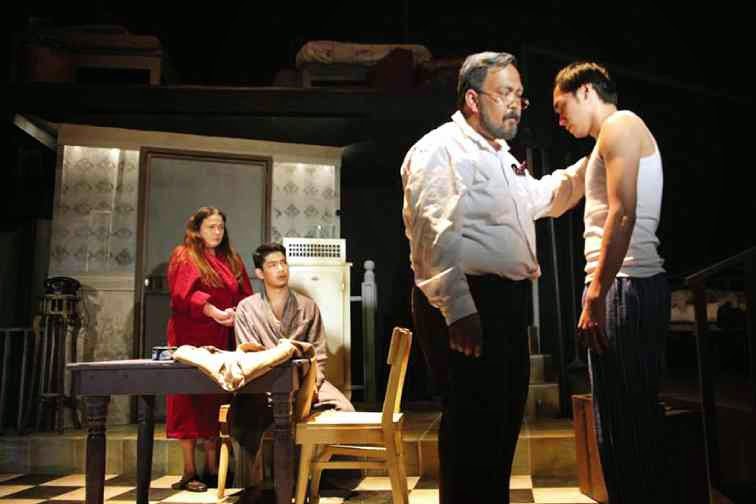
Just came back from watching the translated version of Arthur Miller's Death of A Salesman at the CCP.

I'd read the Pulitzer Prize-winning play at one point in college, but never actually saw a performance. What a difference, indeed, when words on paper are translated into speech and action.

Dramatic, you might even say.

I'll leave the in-depth analyses to bona fide theater critics, and simply stick to my reactions as an audience member. Being seated in the front row - a worthy payoff to showing up early to be first in line, since Tanghalang Huseng Batute is free seating - gives the play an urgency and an intimacy that you simply cannot have in the back rows or the bleachers. Every facial expression, every inflection, every drop of spittle spewing in the heat of the dramatic moment is literally right there in front of your face.

Having the characters actively brought to life, instead of passively lying on the printed page, gave Pahimakas Sa Isang Ahente (the working title they gave this Tinio translation) a raw power and energy that I did not experience the first time I encountered Miller's opus. The impassioned love-resentment tango between Willy Loman and his favorite son, Biff; the failures and shortcomings of all the members of the Loman family; and the aching sadness and helpless frustration of realizing that one's life can amount to so little in terms of legacy hit a little too close to home. 

More than once, I saw my father and myself in Willy and Biff, and my ongoing love/anger relationship with him gets mixed with a drop of insight into how frustrated he must be at his unwanted and unplanned retirement; his unspoken aspirations for me (unlike Loman's very strident ambitions for his son); and whether the sum total of his life achievements tally with his own personal calculations, and how much - or how little - discrepancy there is in the balance sheet.


When Biff grabs his father in a pleading, desperate embrace in the middle of a furious, drawn-out fight near the climax, it was really, really too close to home. 


No, scratch that.


It was a direct hit.


I almost, almost wept, memories of an almost exact scene my own father and I played out in real life years ago rising like a geyser of emotion.

Goddamn, I don't get that kind of poignancy from a telenovela, although the essence of Miller's play is human frailty leading to a family tragedy - something that's squarely in the wheelhouse of any dramatic serye.

I suppose it's this universality, coupled with Tinio's translation - while imperfect - that makes the play more accessible.( He could've easily changed the locations and the currency to local Filipino ones without losing anything of substance, but these are minor quibbles.) Indeed, while the audience (largely composed of high schoolers, undoubtedly and literally on assignment) tended to laugh at crucial, inopportune moments (I don't recall the play having much levity), the sniffles came loud and clear when Willy Loman's ultimate fate dawned upon them. (A denouement cannily sidestepped by the Tagalog title; pahimakas is not a word familiar to even I, and it was my dinner companion - an older female colleague - who illuminated me on its meaning: a romantic term for goodbye .) 


Pamamaalam, in short.


Although I am more partial to its other meaning: testament.


tes·ta·ment
ˈtestəmənt/
noun
  1. 1
    a person's will, especially the part relating to personal property.
  2. 2
    something that serves as a sign or evidence of a specified fact, event, or quality.
    "growing attendance figures are a testament to the event's popularity"
    synonyms:testimonywitnessevidenceproof, attestation; 
    demonstrationindicationsymbol, exemplification; 


For indeed, Miller's play is a testament to the paltry sum of a man's lifelong labors, the evidence that is lacking in terms of its meaning, its monumental tragedy. It is also something we, the audience, bear witness to.

If Miller's words are moving in and of themselves, it is the actors who give his play its raw life force. The members of CCP's resident Tanghalang Pilipino troupe, led by the explosive 29(!!!)-year old Jonathan Tadioan (alternating with the more age-appropriate Nanding Josef) as the Loman patriarch, and ably supported by Raquel Pareño (alternating with mom Gina) as Linda, his loving, loyal wife; Marco Viaña (alternating with Yul Servo) as Biff, the eldest, favored son; and Ricardo Magno as Happy, the younger Loman, breathe passionate, angry, flailing life to the Greek tragedy of the Loman family. 

A universal tale so enduring that the relevance of the Tony Award-winning 1949 play resonates with such cruel clarity to this day.


=====================

P.S.

Full disclosure.

I had casually wanted to see this play because of a running joke about going to see Yul Servo (the other, more well-known actor essaying Biff) up close and personal, but I'm crushing on tonight's alternate, Marco Viaña. Which comes as a surprise to me because 1.) I haven't crushed on anyone for a loooooong time; 2.) I don't normally go for skinny, maputi guys (hence the thing for Yul "The Brown Animal" Servo). 

But who can figure out these things? I think I got sold when Viaña (who strikes me now as a young Tommy Abuel) started weeping at a key point in the play. Weakness usually incites predatory instincts instead of pity in me, and yet, seeing him trembling in betrayed anger, looking so innocent and vulnerable, just made me want to go over and hug him (and maybe cop a feel or two.)


I just want what's best for you.

And maybe I wasn't the only sucker for vulnerability in an angry young man, if the shrieks of the girls as Viaña came out for curtain call was any indication.

It was like the sound of a thousand vaginas screaming.

Never thought Miller time could be thriller time.


=====================

You can still catch Pahimakas Sa Isang Ahente on Oct. 18, Sat. and Oct. 19, Sun. at 3 pm.


Saturday, January 25, 2014

Something Wicked This Way Has Come


Caught Wicked on opening night last Wednesday.

What a wonderful way to open the 2014 cultural season.

Was apprehensive about technical glitches, it being opening night and all, but apart from a flying monkey's wings not opening all the way, everything went fabulously.

The two leads evoked the original duo - Menzel and Chenoweth - with their powerful, distinctive voices and overall presence. And for once, my bad eyesight did me a small favor, allowing me to imagine the original leads onstage.

It was a thrill to witness my favorite numbers from the musical being performed live. And as I predicted, it was Popular that ignited the crowd to roaring laughter and applause and set the tone for the rest of the night.


Ooh, project!


As the song goes "It's all about po-pu-lar!"

Strangely enough, while the signature song "Defying Gravity" was goose-bumpingly soaring and powerful, I found myself struck with a song I didn't really pay much attention to before: romantic but witless lead Fiyero's ode to a carefree existence  "Dancing Through Life" :


Hey, look! It's Enjolras.

Maybe when life has furrowed our brows with many cares and worries, an unexamined life seems worth living instead.

The trouble with schools is
They always teach the wrong lesson
Believe me, I've been kicked out
Of enough of them to know

They want you to become less callow
Less shallow
But I say: why invite stress in?
Stop studying strife
And learn to live
"The unexamined life"

Dancing through life
Skimming the surface
Gliding where turf is smooth

Life is painless
For the brainless
Why think too hard
When it's so soothing?

Dancing through life
No need to tough it
When you can slough it off
As I do?

Nothing matters
But knowing nothing matters
It's just life
So keep dancing through

Dancing through life
Swaying and sweeping
And always keeping cool

Life is fraught less
When you're thoughtless
Those who don't try
Never look foolish

Dancing through life
Mindless and careless
Make sure you're where less
Trouble in life

Woes are fleeting
Blows are glancing
When you're dancing
Through life

Dancing through life
Down at the Ozdust
If only because dust
Is what we come to

And the strange thing
Your life could end up changing
While you're dancing
Through!


At any rate, do try and catch Wicked. It's a tale about friendship and love, alternately funny and poignant.


Kristin Chenoweth's farewell performance. 
Which lent the scene a special kind of poignancy.


In short, it's wicked good.


Monday, December 2, 2013

The Bare Bones of Andrew Good Fate.


I'm not big on Philippine history and national heroes, but for some reason I felt like observing Andres Bonifacio's 150th birth anniversary by watching San Andres B. A new opera boasting of a pedigreed line-up, from librettist and National Artist for Literature Virgilio Almario; Prof. Chino Toledo, composer and musical director; and esteemed director Floy Quintos.


In his production notes, Quintos candidly states that San Andres B. 


"is not opera in the classical mode, nor is it a pop or rock opera. Rather, in Chino Toledo's words: it is a new new opera."

"Toledo's score captures the conflict, the struggle, the dilemma with unrelentingly jagged and edgy musical lines," he added.


Well. 

I thought it was a jangly mess. The music was unmelodious, the libretto unmemorable, and there were no outstanding set pieces that, imho, immortalized what the opus was trying to say. And as a casting aside, the guy portraying Emilio Jacinto had more physical presence and stronger vocals than the one playing the eponymous lead.


Sorry, Floy. Then again: 


"In the local art scene, it is time for something unfamiliar, disturbing, strange. It is time to hear something new. I told the singers na ang dream ko for San Andres B. is, well, remember how Stravinsky's 'Rite of Spring' was first greeted by the audience during its premiere? Riots. Hisses. Boos and bravos! Ganun ang gusto ko mangyari,' he said."


But it's an ill wind that blows nobody good. Because I could barely make heads nor tails of what was going on in Bonifacio's life from the goings-on onstage, in between the orchestra often drowning out the singers and me nodding off like a peasant (horrors!) at the opera, I promptly researched the next day on the life of Gat Andres de Castro Bonifacio. The man who, for some people, should rightfully be regarded as the First President of the Philippine Republic.


--------------------


From what little I can recall from school, I remember Bonifacio was the Great Plebeian hero, who ultimately got the short shrift and was murdered on the orders of a treacherous, power-hungry Emilio Aguinaldo. Even as a child I could not comprehend the injustice of a cold-blooded, calculating turncoat becoming President of the Republic. But since then, local history has abundantly shown that any son of a bitch (or simply a bitch, ain't it so, Madame?) can sit and lay waste to the land from the throne of Malacañang.


And if it is the victors who truly write history, then the story of Bonifacio is truly Filipino, and truly one of woe.


Unlike his illustrado counterpart Rizal, Bonifacio was a true picture of the Filipino masses. Even his life story reads like a telenovela. Born of a working-class father and a mestiza mother, young Andres had to stop schooling when his parents both died from illness. He supported his younger siblings by making canes and paper fans,as well as posters for business firms.

Bereft of further formal education, he was largely self-taught. He avoided ignorance by becoming a voracious reader, devouring anything from Victor Hugo's Les Miserablés, to his own countryman Rizal's Noli and Fili. Doubtless these novels influenced his later political and social leanings.

When he grew older, Bonifacio became a bodeguero, while acting on the side in moro-moro plays. Continuing the theme of a storied life, he was married twice: first to a woman who contracted leprosy and died. And then the second time, to Gregoria de Jesus, who bore him a son, Andres, who soon died of smallpox in infancy. This was after their house burned down during Holy Week of 1896, of course.

Needless to say, the etymology of the name "Bonifacio" is "good fate."


Bonifacio joined Rizal's short-lived La Liga Filipina, an organization which called for political reforms in the Spanish colonial government. The league was disbanded after just one meeting due to Rizal's arrest and deportation to Dapitan. On the day of Rizal's arrest - 7 July  1892 - Bonifacio and others founded the Katipunan

The Kataas-taasan Kagalang-galangan Katipunan was a secret society with links to Freemasonry, that advocated armed struggle against Spanish colonial rule. The Katipunan was composed largely of lower and middle class men, but later opened its membership to include women, as well. It was within this society that Bonifacio formed a lasting friendship with Emilio Jacinto, who would become his adviser and confidante.

Even after founding the KKK, Bonifacio continued working simultaneously with La Liga Filipina, which eventually fractured along socio-economic lines as much as ideological ones. The more conservative, wealthier members opted to support the Cuerpo des Compromisarios - political reformists located in Spain. "Radicals" from La Liga, like Bonifacio, were subsumed into the KKK.

The KKK grew so rapidly, from 300 members in January of 1896, to 30,000 by August, that it was inevitable that the Spaniards would eventually learn of the existence of the secret, seditious society. It's sad to note that it was a disgruntled Katipunero, Teodoro Patiño, who confessed to a Fr. Mariano Gil about the existence of the secret, sacrilegious Freemason-like society. 


Bonifacio wanted to launch an armed revolt as soon as possible, but Aguinaldo demurred, citing a lack of available firearms. The decision was made to consult Rizal in Dapitan, who also advised against a premature revolution and recommended more preparation.

But events soon overtook everyone, as history happens, and the Spaniards cracked down on hundreds of Filipinos - Katipunan members and innocent non-members alike. Bonifacio, Jacinto, and Guillermo Masangkay disguised themselves as sailors and boarded a ship where Rizal was being held, awaiting to sail to Cuba, where he had agreed to work as a doctor for the Spanish colonial forces in exchange for his release from Dapitan.


Bonifacio and company had wanted to rescue Rizal so he could join the revolution, but Rizal rejected their offer. Eventually, he, too would be arrested, tried and executed.•

After eluding a massive manhunt, Bonifacio called for a massing at Caloocan, where the Philippine uprising was to be launched. The "Cry of Balintawak/Pugad-Lawin" opened with a symbolic gesture of the tearing of community tax certificates: the infamous cedulas. Bonifacio reorganized the KKK into a de facto revolutionary government, with himself as President and Commander-in-Chief.


The rest, as they say, is history. But what's far more interesting to me are the footnotes, rather than the Big Picture.


------------------------


There's Bonifacio's little-known National Anthem: a hymn he commissioned from Julio Nakpil entitled Marangal Na Dalit Ng Katagalugan.** Aguinaldo later rejected it in favor of an anthem he in turn had commissioned: the Marcha Nacional Filipina, which was to become the basis of the Lupang Hinirang we know today.


Then there was the infamous fracturing of the Katipunan chapters. The Magdalo, headed by Aguinaldo's cousin Baldomero Aguinaldo, and the Magdiwang, headed by Mariano Alvarez,the uncle of Bonifacio's wife, Gregoria. In time the friction between the nepotistic factions would result in a chasm that would eventually engulf Bonifacio.

There were also the shady elections at the Tejeros Convention, assembled to determine once and for all who was in charge of the fledgling Philippine government. While Bonifacio received the second highest number of votes next to Aguinaldo, the suggestion to proclaim him as Vice-President of the Biak-Na-Bato Republic was ignored, and elections proceeded. Instead, he was nominated Director of the Interior, a move contested by eternal malcontent Daniel Tirona on the grounds that Bonifacio was not a lawyer and thus could not hold that office.

So fraudulent were these elections, so marred with whispers of cheating that Bonifacio declared them null and void in his Acta de Tejeros. His rejection of the election results and his accusations of treason against its hastily-inducted President (for negotiating with the Spaniards) led to Aguinaldo promptly consolidating his power and ordering the arrest of Bonifacio.

Leading us, of course, to the infamous trial of the Bonifacio brothers, a mockery of justice resulting in their execution (some say legal murder). Prompting Mabini to declare it as criminal and the "assassination …the first victory of personal ambition over true patriotism." (Interestingly, one of Bonifacio's supposed murderers was Gen. Lazaro Macapagal, grandfather to Gloria Arroyo.)


----------------------


In San Andres B., the Greek chorus repeatedly warns Andres that "Mahirap maging bayani."

They predict the future, with its treachery, disappointments, and Bonifacio's own ignoble end. And when they ask if he is willing to accept these as the price of freedom, he immediately, defiantly proclaims "Yes!"


Nothing seems to have changed much since then, from where I stand.


Which kind of makes you wonder if our heroes only die in vain. Or whether the Filipino - in his great unwillingness and/or inability to learn from history - is truly worth dying for.


And then, there's this: Police, soldiers dismantle parts of photo exhibit about Bonifacio.


================
Footnotes from Wikipedia:

* José Rizal is generally considered the National hero, but Bonifacio has been suggested as a more worthy candidate on the grounds of having started the Philippine Revolution. Teodoro Agoncillo writes that Rizal is a "United States-sponsored hero" who was promoted as the greatest Filipino hero during the American colonial period of the Philippines - after Aguinaldo lost the Philippine-American War. The United States promoted Rizal, who was taken to represent peaceful political advocacy, instead of more radical figures whose ideas could inspire resistance against American rule. Specifically, Rizal was selected over Bonifacio who was viewed as "too radical" and Apolinario Mabini who was "unregenerate."

** The term Tagalog historically refers to an ethnic group, their language, and script. While historians have thus tended to view Bonifacio's concept of the Philippine nation as restricted to the Tagalog regions of Luzon, as compared to Aguinaldo's view of Luzon, Visayas, and Mindanao (comprising the modern Philippines), Guerrero writes that Bonifacio and the Katipunan in fact already had an all-encompassing view. The Kartilya defines "tagalog" as " all those born in this archipelago; therefore, though Visayan, Ilocano, Pampango, etc. they are all Tagalogs."

Friday, August 16, 2013

The Clique of Claqueurs.


"Everything's beautiful at the ballet...hey," sang the character Sheila in A Chorus Line.


And it is.

Mostly.


If you ever saw Black Swan, you'd have had some idea how ruthless things can get in the business of producing ephemeral works of art and beauty. And as if to drive home that point, in Russia, there is a middle-aged clique who controls the professional-applause racket at the Bolshoi.

That's right. This is a thing.


"Don't cry. Pay."


If the Chinese have professional Crying Ladies, the Russians have professional Applauders. And while the very idea sounds farcical at first thought, giving credit where credit is due was not always the norm in the performing arts:


The idea that applause in response to performance should be spontaneous is a relatively new one. Roman emperors trained professionals to mingle with crowds at key moments, encouraging the dull roar of approval that speaks of a mandate. This behavior was refined in the theaters of 18th- and 19th-century France, where the term “claque” — from the phrase “to clap” — was coined. At the Paris Opera, claqueurs became mighty arbiters of theatrical success; Balzac writes in “La Comédie Humaine” that the chief of the claque had “the endorsement of the boulevard playwrights, all of whom have an account with him, as they would with a banker.”


And even in this late day and age, the modern claqueurs wield enough power to actually sabotage a danseur's performance:

It is possible, for instance, to clap off-rhythm when a dancer is performing the series of difficult turns called fouettés, he said. “Kolya fell down because of us many times, because I was at war with him for years and arranged these things for him,” he said, of Mr. Tsiskaridze. “Poor guy, in ‘Raymonda’ he screwed up the whole variation and flew off and ended up with his nose on the floor. In ‘Nutcracker’ once, I made him drop his fouetté, from way up high, and he sat down on his bottom, butt facing the hall. And we all laughed.”

Faux-pas de deux?


Read more at the link. 


In the meantime, this gives me a deliciously wicked idea for Giselle tomorrow night.


Wednesday, June 5, 2013

Love Potion No. 9


Worshipping at her feet: Adina reads Tristan Und Isolde, 
giving impressionable Nemorino the idea of finding a love potion.


Love is a drug.

But love is also a disease that seeks a cure.

Entonces: let's brew a love potion.

After the Verdi double-whammy of a lovers' sacrifice in Aida and the karmic retributions in Rigoletto, Donizetti's comic L'Elisir d'Amore - the third in CCP's ongoing Met Operas in HD series - is a breath of fresh air. An opera that, for once, doesn't end in tragedy.

It is the bel canto equivalent of a rom-com, although this 2012 Met season opener is played more "straight" than the usual loopy stagings. The formula for L'Elisir is familiar: klutzy boy pines after popular girl; girl is disinterested. Boy feigns losing interest in girl; girl suddenly sits up and takes notice. Add a cocky rival and a sly charlatan to the mix, and you've got the ingredients fit for a vehicle for a 19th century Katherine Heigl.


Bizarre Love Triangle : Decisions, decisions.


While opera's themes are timeless, I'm still grateful the Met didn't transpose L'Elisir to a more modern era like what they did with Rigoletto, but kept it firmly in the original 19th century Italian countryside setting. The rustic period costumes and painterly sets all help contribute to the flight of artistic fancy, although I must admit I'm curious to see the 1978 production that set it in the Wild West, with its homesteads, frontier towns, and of course, its snake-oil salesmen peddling hope and quackery in equal measure.

Again, the Met isn't lacking for talent, and the key players in this production deliver spectacularly. Russian soprano Anna Netrebko - a dead-ringer for Lynda Carter - is perfectly cast as the coquettish yet headstrong  landowner Adina. Italian-American lyric tenor Matthew Polenzani is sympathetic and endearing as the lovestruck, simple-minded commoner Nemorino. And Polish baritone Mariusz Kweicień makes an effective - if a tad nasty - contrast as his rival, the arrogant ladykiller Sergeant Bercole.


Hawking Hopes and Dreams: Dr. Dulcamara makes his pitch.


Italian baritone Ambrogio Maestri essays the role of Dr. Dulcamara, the quack doctor in a fancy traveling carriage who sells the gullible Nemorino the titular elixir of love, which sets the events of the opera in motion. He brings an irresponsible, irrepressible jollity to the part - almost as though Santa Claus came to town and conned cure-alls for a crown instead of bearing gifts. Maestri's big, majestic voice and great comic timing lend the part a quirky, gleefully amoral weight, and he conveys a presence large enough - literally and figuratively - to play Louis XIV if ever an opera about the decadent Bourbons were to be penned.


Coy with boy : Adina donna é mobile.


Netrebko plays the village prima donna Adina with an easy earthy sensuality, complemented by her robust, full-bodied voice. It's a shame Adina's solo early on isn't remarkable enough to showcase Netrebko's shimmering pipes; instead, her soaring curlicues are mostly spent embellishing (admittedly-lovely) duets with her male co-stars and adorning the rousing ensemble numbers.


Fickle femme: I've set you free. Now stay with me.


Ironically, I wasn't expecting Donizetti's light, airy opera to move me the way Verdi's heavy tragedies couldn't. But Matthew Polenzani's rendition of Una Furtiva Lagrima - the most famous aria in this oeuvre -poetically brought a furtive tear to my eye:


Polenzani starts off pretty unremarkably, misleading us with what seems like a competent but average rendition, but ambushes the audience as he kills the solo toward the end (starting at 4:20). If the thunderous minute-long applause and shouts of "Bravo!" aren't proof enough, your ears - if not your very soul - are dead as lead.


Even without glancing at the subtitles, the music was more than enough to convey the breadth and depth of the emotion.


Living proof that music - like love - truly has the power to move you.


Except with music, you don't need no magic potion.


Will They Or Won't They? Are you kidding?


You can watch the entire thing here. Enjoy!